
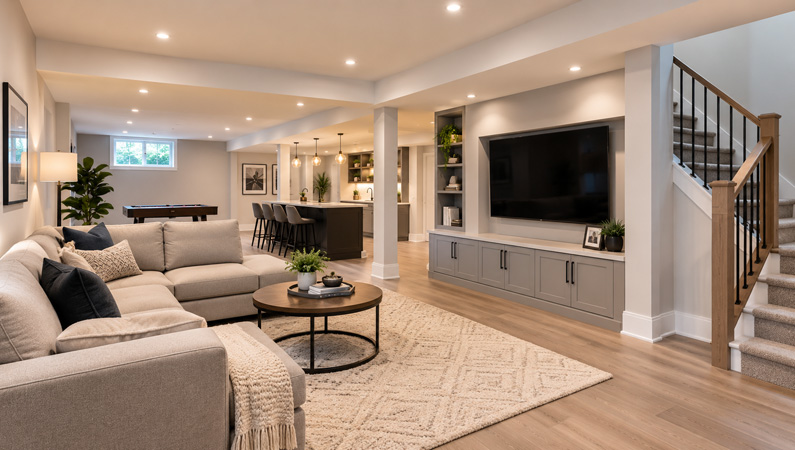
An unfinished basement is one of the most overlooked spaces in a Toronto home. It’s already there, already enclosed, and already paid for in your mortgage — yet in most houses it sits half-used as storage. Finishing it properly turns that square footage into a family room, home office, or extra living space.
This guide walks through what basement finishing actually involves and the order the work needs to happen in, so you know what to expect before the first wall goes up.
Finishing vs. Renovating: Know the Difference First
“Basement finishing” and “basement renovation” get used interchangeably, but they’re not the same scope. Renovation can involve moving walls, running new plumbing for a kitchen or bathroom, or converting the space into a legal secondary suite. Finishing takes an unfinished shell — bare concrete, exposed joists, unfinished walls — and turns it into a comfortable, usable room without changing its footprint.
A typical finishing scope includes:
- Framing and insulating exterior walls
- Drywall installation and painting
- Flooring suited to below-grade moisture (laminate, vinyl plank, or engineered hardwood)
- Ceiling treatment (drop ceiling or drywall)
- Electrical upgrades, including proper lighting and outlet placement
- Basic HVAC adjustments for even heating and airflow
If your plans include a bathroom, a separate entrance, or a rental suite, that’s a larger scope — our full basement renovation page covers what’s involved there, including current pricing.
Step 1: Start With a Moisture Assessment, Not a Floor Plan
Toronto basements sit below grade, which means moisture management isn’t optional — it’s the foundation of a durable finish. Framing over a damp foundation wall or laying flooring over an unresolved leak is one of the most common and expensive mistakes homeowners make.
Before any design decisions, check the space for:
- Visible efflorescence or staining on concrete walls
- Cracks wider than a hairline
- A musty smell or history of seasonal dampness
- Grading and downspout issues outside the home
Any of these usually means waterproofing needs to happen before framing starts, not after.
Step 2: Plan the Layout Around What’s Already There
Unlike a main-floor renovation, a basement layout is constrained by existing elements: support columns, ductwork, the furnace and electrical panel, and ceiling height. Good basement design works with these rather than fighting them — building storage or a bar around a support column, for example, instead of trying to hide it.
This is also the stage to decide on ceiling height solutions if your basement feels low. Dropped ceilings are the simplest route, but there are ways to gain a few extra inches where headroom is tight.
Step 3: Confirm What Needs a Permit
Most basement finishing work in Toronto that involves new framing or electrical changes requires a building permit — cosmetic-only updates, like repainting or replacing existing flooring, usually don’t. Because permit requirements depend on your specific scope, it’s worth confirming with your contractor early rather than assuming either way.
The City of Toronto’s BuildSafeTO permit page outlines what triggers a permit, and structural requirements follow the Ontario Building Code. For a full breakdown of permit and cost specifics for basement projects, our basement renovation page’s FAQ section covers current requirements and pricing ranges.
Step 4: Sequence the Build Correctly
Once the moisture check, layout, and permit are sorted, a well-run finishing project follows the same general order:
- Framing and insulation — building out walls against the foundation
- Rough electrical — wiring for outlets, switches, and lighting
- Drywall, taping, and painting
- Flooring and trim installation
- Final inspection and walkthrough
Skipping ahead — flooring before electrical is finalized, for instance — is how homeowners end up paying to redo finished work.
Step 5: Budget With Some Room to Move
Finishing costs depend heavily on square footage and finish level, from basic drywall-and-flooring work up to custom millwork and premium materials. Rather than pricing your project off a general number, it’s worth getting a scoped estimate, since Toronto basements vary widely in what they need before finishing can even begin (waterproofing, electrical upgrades, or ceiling adjustments all shift the number).
Building in a contingency for what the moisture assessment or an opened wall might reveal is standard practice — it’s the most common reason basement budgets move mid-project.
Getting Started
A finished basement is one of the more practical upgrades a Toronto homeowner can make — it adds usable space without the cost of an addition, and it shows up when it’s time to sell. The part that matters most is sequencing it correctly: moisture check first, layout and permits next, then framing and finishes.
With 20+ years of experience finishing and renovating basements across Toronto and the GTA, iRemodel Home Renovation Toronto handles the assessment, permitting, and construction so the process stays straightforward from start to finish. For more on what to expect going in, our guide on what to know before a basement renovation is a useful next read, and our service areas page lists the Toronto neighbourhoods we work in regularly.
Call (416) 825-2542 or book a free consultation to talk through your basement finishing project. iRemodel Home Renovation Toronto is located at 18 Yorkville Ave, Toronto, ON M4W 3Y8.
About the Author